
How UK Schools are Managing Shared Devices in 2026
Industry Research Report
Based on research conducted with the ANME community and analysed by LapSafe®
Executive Summary
Digital technologies play an increasingly important role in schools, supporting teaching, learning and administration. To better understand current approaches to device access and management, LapSafe® analysed responses from school IT professionals collected through the ANME community.
The findings highlight widespread adoption of integrated authentication technologies alongside established approaches to device storage and distribution.
Key findings include:
· 92.9% of respondents reported using Active Directory.
· 68.4% reported using RFID smart cards for authentication.
· 31.2% reported using biometric authentication methods.
· 81.6% reported using staff-led device distribution.
· 75.8% reported using charging trolleys for device storage.
Taken together, these findings provide a snapshot of how UK schools currently manage authentication, device access and storage.
About the Research
This report is based on responses collected from school IT professionals through the ANME community. Respondents represented a range of schools and multi-academy trusts across the UK.
The survey explored:
· Authentication technologies
· Systems integration
· Device distribution methods
· Device storage solutions
The findings provide an overview of current practices at the time of the survey.
Authentication Technologies in UK Schools
The survey found widespread adoption of centralised authentication technologies.
Systems and integrations
Respondents identified the following systems as being used within their schools:
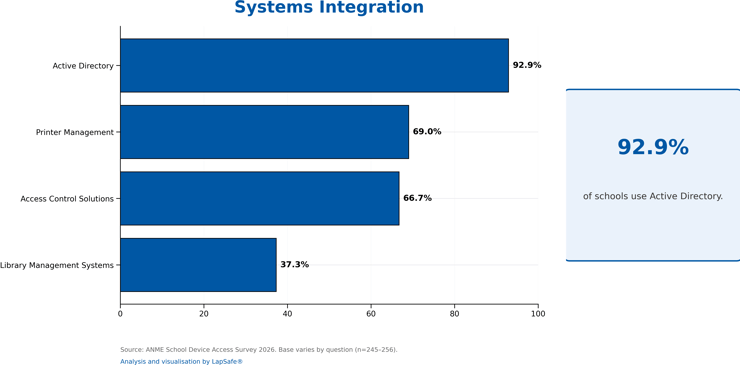
Active Directory was the most frequently selected option, with nearly 93% of respondents reporting its use.
Authentication methods
Schools reported using a range of authentication methods:
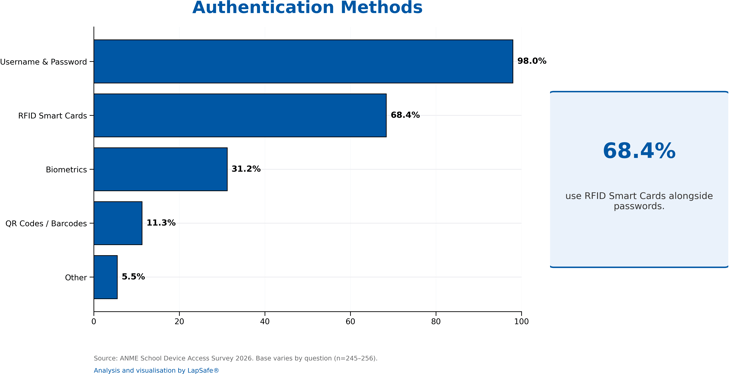
Many respondents indicated that multiple authentication methods are used within their environment.
The findings show that alongside traditional usernames and passwords, RFID cards and biometric technologies are also used by a significant proportion of schools.
Device Distribution in Schools
The survey also examined how devices are distributed to users.
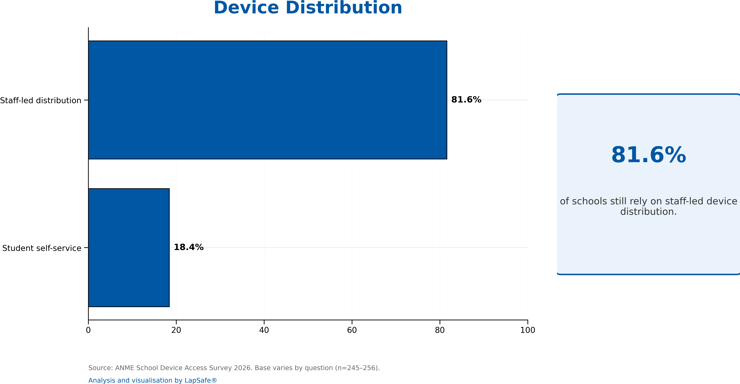
More than four in five respondents reported using staff-led distribution, in which staff members issue devices and remain responsible for them.
A smaller proportion reported using student-led distribution, where users collect devices themselves and take responsibility for them.
The survey did not explore the reasons behind these choices, but the findings indicate that staff-led distribution remains the most common approach among respondents.
Device Storage Solutions
Schools were asked how devices are stored when not in use.
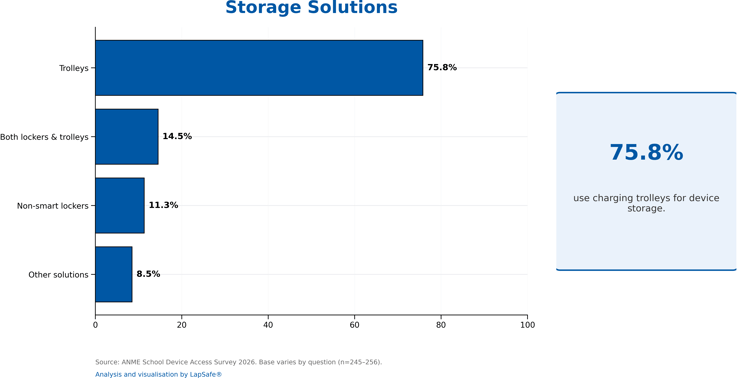
Charging trolleys were the most commonly reported storage solution, being used by more than three-quarters of respondents.
Some schools reported using a combination of storage methods, including lockers and trolley-based solutions.
Additional Approaches Identified in Responses
Survey comments highlighted a variety of approaches to device storage and access.
Examples mentioned by respondents included:
· RFID-enabled lockers
· Smart self-service laptop lockers
· One-to-one device programmes
· Home charging arrangements
· Loan device schemes
· Existing LapSafe® deployments
These comments demonstrate the range of approaches currently being used across different schools and trusts.
Observations from the Data
The survey identified widespread use of integrated authentication technologies.
At the same time:
· 92.9% of respondents reported using Active Directory.
· 68.4% reported using RFID authentication.
· 81.6% reported using staff-led device distribution.
These findings indicate that authentication technologies and device distribution processes are both important components of device management within schools.
The survey did not seek to determine which approach is most effective. Instead, it provides a snapshot of current practice across participating schools.
Conclusion
The findings show that UK schools use a wide range of technologies to manage access to systems and devices.
Active Directory was the most commonly reported system integration, while usernames and passwords remained the most widely used authentication method. A significant number of respondents also reported RFID cards and biometric technologies.
In terms of device management, staff-led distribution and charging trolleys were the most commonly reported approaches. However, responses also highlighted the use of alternative models, including locker-based systems, self-service access and one-to-one device programmes.
Together, these findings provide an overview of how participating schools currently approach authentication, device access and storage.
Expert Commentary from LapSafe®
What the findings tell us about device access in schools
The survey highlights the important role shared devices continue to play within UK schools. Whilst every school operates differently, the findings suggest a common requirement: ensuring devices are available, charged, secure and ready for use when needed.
One of the most striking findings is the contrast between authentication technologies and device distribution methods.
The survey found that 92.9% of respondents use Active Directory, 68.4% use RFID authentication and 31.2% use biometric technologies. At the same time, 81.6% reported that devices are still distributed through staff-led processes.
These findings underline the fact that both digital identity management and physical device management remain important considerations for schools.
There is no single approach to device management
The survey demonstrates that schools use a variety of methods to manage devices, reflecting different operational requirements, staffing structures and learning environments.
For many schools, charging trolleys continue to provide an effective solution for storing, charging and managing shared devices. The survey found that 75.8% of respondents use trolleys, reinforcing their position as a core part of device management across the sector.
At the same time, survey responses also referenced self-service lockers, RFID-enabled access, one-to-one device programmes and hybrid approaches that combine multiple management models.
These findings suggest that schools are increasingly looking for solutions that align with their own specific operational needs rather than adopting a single model for device access and storage.
Balancing access, accountability and administration
School IT teams are often responsible for supporting large numbers of devices whilst ensuring they remain secure, charged and available for learning.
As device estates grow, schools may consider a range of factors when reviewing device management processes, including:
· User accountability
· Device availability
· Charging requirements
· Administrative workload
· Security and access control
· Scalability across multiple sites
The most appropriate solution will vary from school to school, depending on how devices are used and managed.
Supporting different stages of the device management journey
The survey findings highlight that schools are operating at different stages of their device management journey.
Some continue to rely on traditional shared device pools supported by charging trolleys. Others have introduced locker-based storage, self-service access or one-to-one programmes. Many operate a combination of approaches across different departments, key stages or campuses.
At LapSafe®, we see this variety reflected across the schools we work with. Rather than a move away from one approach towards another, many schools are building flexible device management strategies that combine secure charging, storage and access solutions to meet different requirements.
Looking ahead
The survey provides a snapshot of current practice in UK schools. It shows widespread use of integrated authentication technologies, continued reliance on charging trolleys and a range of approaches to device distribution and access.
As schools continue to review how devices are stored, charged and accessed, the focus is likely to remain on achieving the right balance between security, accessibility, accountability and ease of management.
Whether through charging trolleys, charging cabinets, smart lockers or a combination of solutions, the objective remains the same: ensuring devices are available and ready to support teaching and learning when they are needed most.